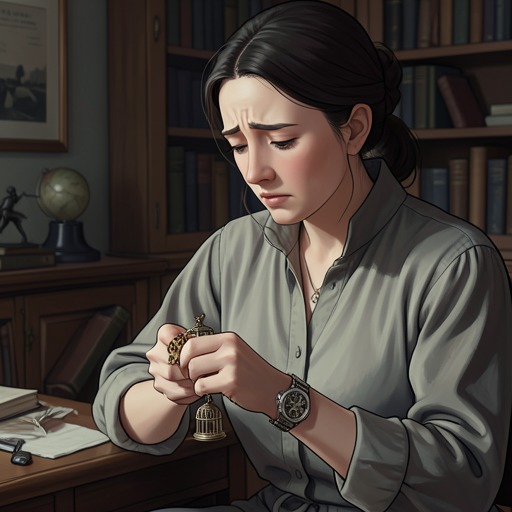
La lettre du docteur Anger au pasteur
Felix AustriaLa lettre du docteur Anger au pasteur is Emil-Karl-Théodore Anger’s final confession and practical appeal: he admits that his neglect helped entangle Stefania and Adèle in a damaging household relationship, accepts the pastor’s offer to take Stefania in, and tries to secure a future for both women before his illness ends his life. Discovered and read by Stefania beside his deathbed, the letter makes private remorse a belated act of recognition, while its account of two lives taking root together gives language to a bond neither woman can easily name or escape.
Discovery and Form
Stefania finds the letter among papers in the house and recognizes the doctor’s fine handwriting, which she likens to poppy seeds. The sight of it brings an immediate rush of tenderness that displaces her other feelings. The letter is therefore not presented as a detached document: its written voice reaches Stefania in a moment of personal upheaval, and her reading is framed by the bodily reality of the author’s approaching death.
Addressed to the pastor, it begins with gratitude for his concern for the doctor and his daughter, and for his work among orphans, the poor, and the unhappy. Emil-Karl-Théodore recalls their discussions about whether God exists, describing the remembered conversations as a source of warmth and luminous joy. His praise of the pastor’s charitable work and his hope for a heavenly reward establish a tone of affection and spiritual intimacy before the letter turns to the more difficult reckoning with his own conduct.
Confession of Neglect
The doctor recalls that he and the pastor had repeatedly argued about Stefania, who had entered his home and become part of it. He admits that he resisted the pastor’s judgment because he was afraid to acknowledge his mistake and wanted to think himself better than he was. The confession is pointedly self-critical: he does not present his earlier decisions as innocent kindness, but recognizes that his self-image helped him evade responsibility.
He says that the pastor was right: he had done harm, above all to his daughter, Adèle, for whom he felt the greatest concern, and also to Stefania, whom he describes as an unaware girl who had quickly learned to see only what suited her. He identifies a specific circumstance behind the damage: absorbed in his medical practice, he neglected both women and left one at the mercy of the other. The letter thus recasts the household arrangement not as a naturally harmonious form of care, but as a relationship shaped in part by the doctor’s absence and the unequal positions he allowed to develop.
His image for the resulting bond is botanical and difficult to separate from the harm he fears. The women, so different in origins, destinies, and roles, are described as pliable and gentle, too naive, taking root in soft, fertile soil until their trunks became intertwined. The image acknowledges their closeness, but does not romanticize it as uncomplicated unity: the doctor calls his own weakness culpable and fears its consequences. He believes the damage is already too late to repair, even as his letter tries to alter what can still be changed.
A Proposed Future for Stefania
The letter’s appeal is not only an apology. With gratitude, the doctor accepts the pastor’s proposal to take Stefania into his home. He recommends her as hardworking, capable, tireless, and exceptionally skilled at cooking and managing a household. His culinary endorsements are specific: he suggests Viennese roast beef with onions and potatoes, or baked poliadvitsa. The recommendation makes visible the practical expertise that defines Stefania’s labor, even as the doctor attempts to secure a setting in which her life might no longer be organized solely around service to the Anger household.
He hopes that the pastor will help Stefania’s “deformed trunk” find support in itself. The phrasing extends the letter’s entwined-tree image into a wish for a different kind of stability: not simply to transfer Stefania’s labor to another household, but to help her become less dependent on the damaged arrangement that has shaped her. Yet the proposal remains an intention, not a completed rescue. The doctor writes that he will soon tell Stefania of his decision and asks the pastor to expect a visit; he has very little time, and the letter does not establish that he succeeds in carrying out that conversation.
Adèle, Death, and the Letter’s Limits
The doctor adds that Adèle is engaged and says he can be reassured about her. Her fiancé is Ruthenian, and the doctor remarks on his unusually aristocratic character. This news distinguishes the futures he imagines for the two women: Adèle’s engagement appears to him to settle his concern for his daughter, while Stefania’s future requires an explicit arrangement with the pastor. The letter offers no equivalent resolution of the women’s own entangled relationship; it records the doctor’s belated recognition and his attempt to intervene from a position of failing health.
Emil-Karl-Théodore closes by asking the pastor to pray for his soul, then signs his full name. After Stefania finishes reading, she is before the doctor’s deathbed: his body is gravely ill, his eyes are bloodshot, and the room bears the sharp smell of medicine and the fluid in a chromed spittoon. That immediate scene gives the letter its final measure. Its promises and admissions arrive when their author is dying, and its account of harm cannot undo the years it describes. The document nevertheless changes what Stefania can know: the doctor had recognized that his neglect injured both women, accepted help for her, and tried, too late to speak directly, to make another future possible.